Lead and Drinking Water

Under the United States Environmental Protection Agency’s (EPA) Lead and Copper Rule Revisions (LCRR), utilities must create an inventory of all the drinking water service lines. Tidewater Utilities, Inc. (Tidewater) is conducting an inventory of water service lines throughout its water distribution systems. This inventory will identify the material of your service line, including if it is made of lead.

Background

Like many other water systems, some of Tidewater’s service area has older homes and buildings that may have lead service lines. Service lines are small, buried pipes that bring water from the water main in the street to buildings. As water travels through a lead service line, lead can leach from the pipe into the treated water delivered to customers. The treated water from Tidewater’s treatment plants and street water mains does not have lead. Existing lead service lines, lead solder in indoor plumbing, and lead in some older plumbing fixtures can cause lead in to occur customers’ drinking water.

Exposure to high lead levels is a serious health risk. Lead builds up in the body over many years and can cause damage to the brain, red blood cells, and kidneys. The greatest risk is to young children, pregnant women, and unborn babies.

Exposure to high lead levels is a serious health risk. Lead builds up in the body over many years and can cause damage to the brain, red blood cells, and kidneys. The greatest risk is to young children, pregnant women, and unborn babies.

Tidewater has been working to reduce lead exposure. To date, Tidewater has taken the following actions:

  • Uses pH control and adds zinc orthophosphate as a treatment chemical in some areas as appropriate.  Zinc orthophosphate coats the inside of the service lines helping to minimize the amount of lead dissolving into the water. Tests water from at-risk homes in the water service areas, in compliance with State and Federal requirements.  For over a decade,
  • The test results have been below the U.S. Environmental Protection Agency’s (EPA) lead or copper action levels per the Lead and Copper Rule.  Detailed information about Tidewater’s water systems and monitoring can be found in Tidewater’s Water Quality Reports here: https://www.middlesexwater.com/tidewater-utilities/.

Who owns the water line?

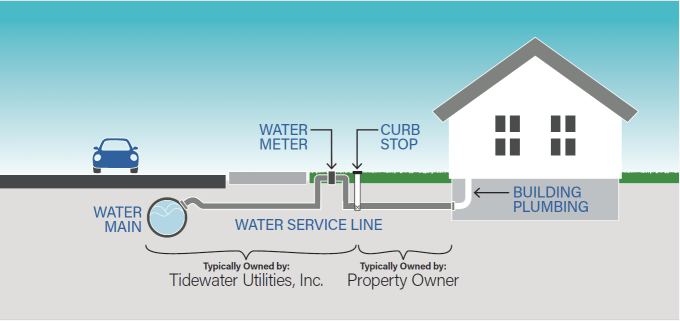
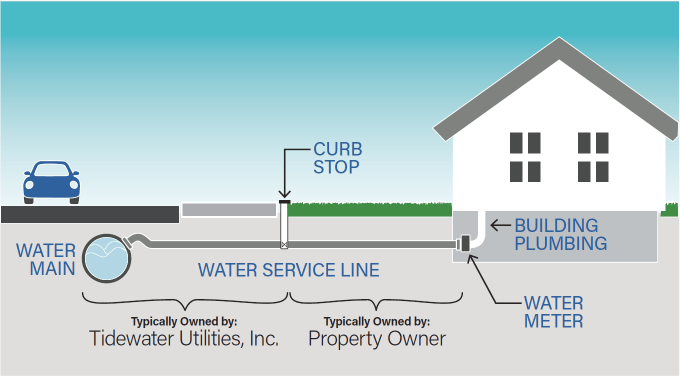
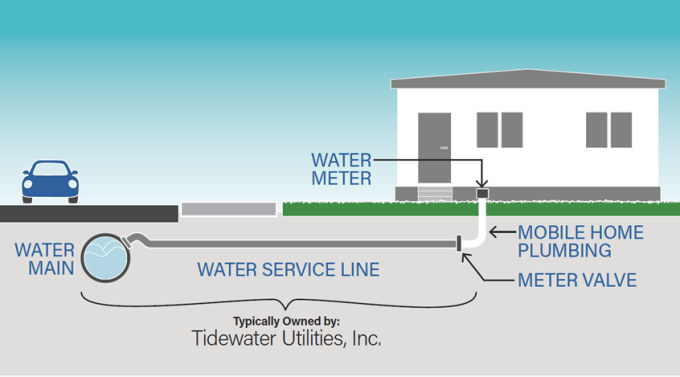
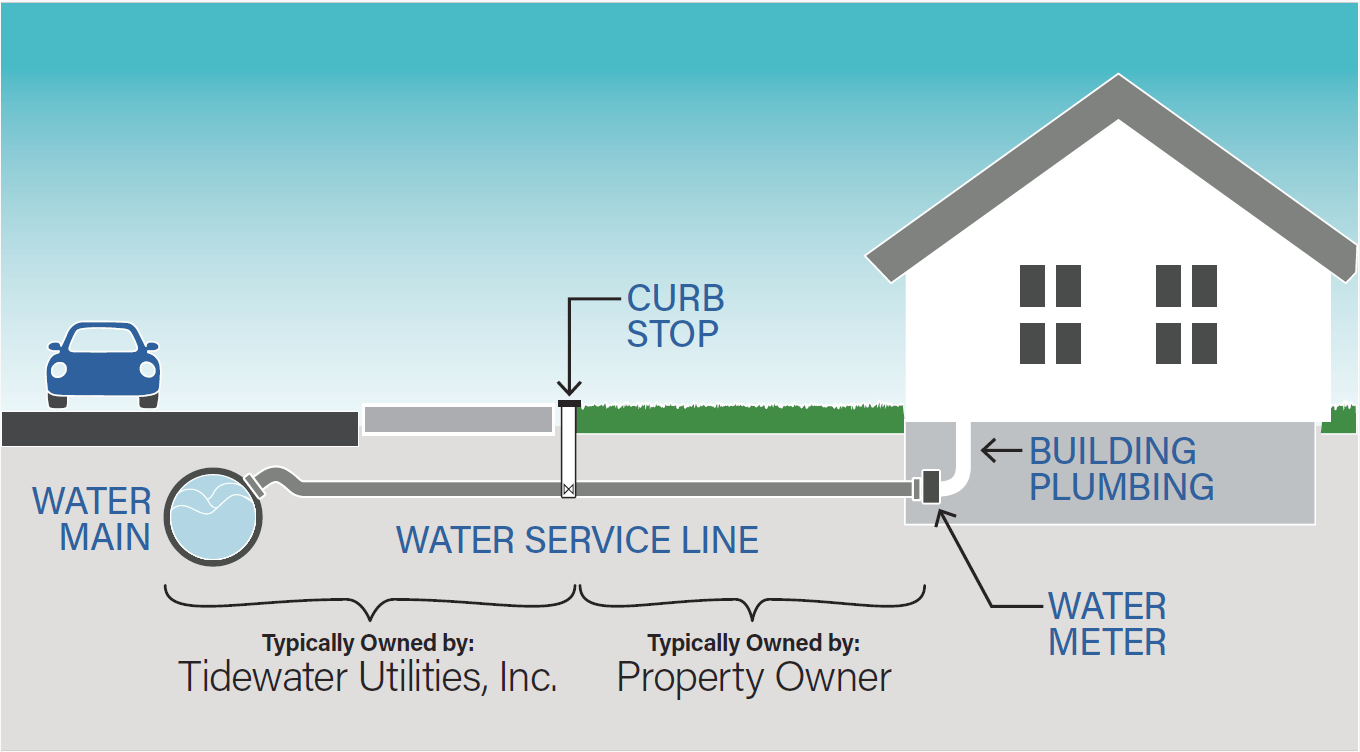
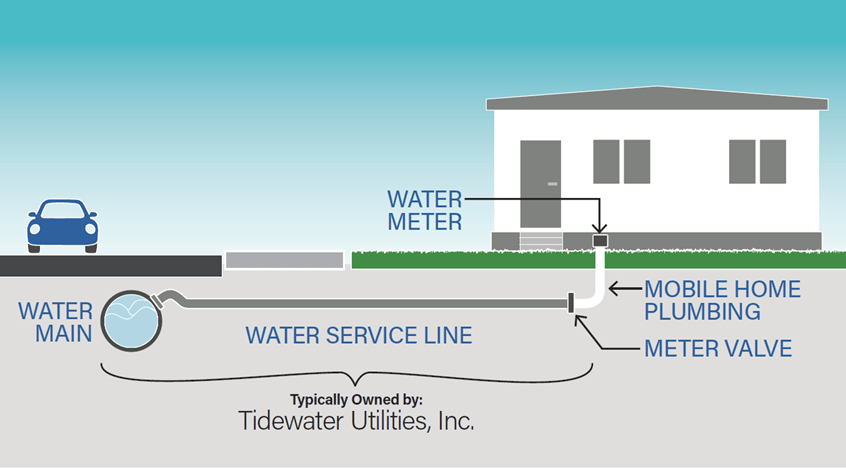
Ownership of the water service line is shared between Tidewater and property owner and depends on the location of the water meter.

For property owners with the meter in a pit outside the home, Tidewater owns the service line from the main in the street to the meter, including the meter. The property owner owns the service line from the meter to where the service line connects to the plumbing inside the home.


For property owners with a meter in the basement, Tidewater owns the service line from the main in the street to the curb stop, typically at the property line or in the sidewalk. The property owner owns the service line from the curb stop to the meter inside the home. Tidewater owns the meter. 

For property owners with mobile home, Tidewater owns the service line up to the meter valve, just before the meter underneath your home. Tidewater also owns the water meter. The property owner owns the plumbing inside the home.


Once you know your service line material, please complete this survey so Tidewater can update its records. An accurate inventory of service line materials helps Tidewater identify the locations of any lead service lines in its service area. Once these lead service lines are identified within our system, we are better able l to prepare a lead service line replacement program plan.

Checking your Service Line Material

Self-Checks

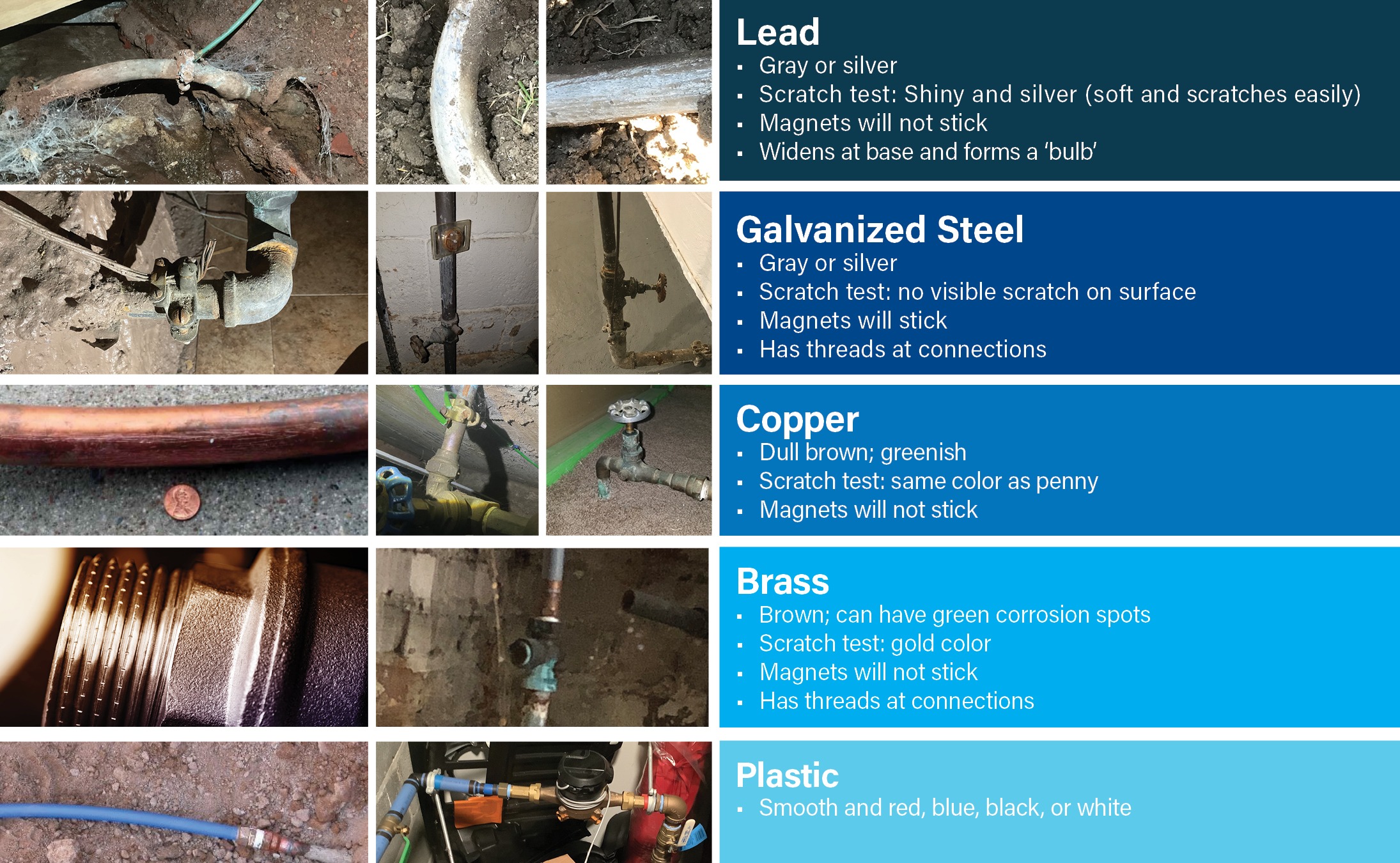
Since Tidewater cannot easily access the part of the water service line located in your home, we need your help to identify the water service line material on your property. Please use this guidance to learn your service line material.

Test Holes

The 2021 U.S. Environmental Protection Agency (EPA) Lead and Copper Rule Revisions require all water utilities, including Tidewater, to prepare an inventory of water service line materials to learn whether the water system has any lead or galvanized steel (which may have lead) water service lines. To check your service line material, Tidewater will be digging small test holes outside of your home to reach these pipes underground.

About one week before the test holes are dug, you will receive a door hanger with the date we will be completing the work. At each test site, our contractor will dig two 12-inch by 12-inch holes on either side of the meter to check the water service line material. It takes about 30 minutes to dig the holes and look at the pipe material. These holes will be dug in the right of way on your property, and you do not need to be home.  After the digging has been completed, the sidewalks will be temporarily cold-patched and the contractor will return on a later date to complete the full restoration of the sidewalk panel. If the pits are dug in grass, these will be filled in and covered with existing lawn. Additional seeding will be added, as necessary.

View Our Current Inventory Map

You can use the map* below to look up your address in our records and learn if you might have a lead service line.

View the Inventory maps above to see if we have information for your service line. If not, the Materials Verification Test below can help you figure out if you have a lead, galvanized steel, copper, or plastic service line on the part of the service line you own. When you have completed the visual inspection, please submit your results using the following survey link.

This tool is only for Tidewater customers in New Castle, Ken, and Sussex Counties.

Search for your address using the search bar at the top-right corner of the map.

On a mobile device? We recommend using full-screen app.

Can’t find your address? Please be sure you have entered it correctly in the search tool. If your address is not on the map or no instructions are provided, that means the address is not associated with a Tidewater account.

Learn More about Lead in Drinking Water

Exposure to high levels of lead is a serious health risk. Lead builds up in the body over many years and can cause damage to the brain, red blood cells, and kidneys. The greatest risk is to young children and pregnant women and their unborn babies.

The following content provides information about:

  • Public health risk from lead
  • Flushing your service line to temporarily remove lead
  • Water filters to remove lead
  • Testing your water for lead

Public Health In children, low levels of exposure to lead have been associated with damage to the central and peripheral nervous system, learning disabilities, shorter height, impaired hearing, and impaired blood cell formation and function. Lead can also cross the placental barrier, exposing the fetus to lead, causing reduced growth and premature birth.

Most lead exposure comes from contaminated soil, dust, or paint chips. However, while rarely found in water leaving a treatment plant or traveling through a main, lead can be in drinking water. Lead enters water as a result of corrosion, as water comes into lead pipes connecting homes to water mains. Lead can also enter water when it comes in contact with lead materials in indoor plumbing and plumbing fixtures. Since you cannot see, taste, or smell lead in drinking water, customers should know if their service line or parts of home plumbing have lead, and replace what may have lead.

Flushing Your Service Line Running your water at the faucet, also known as “flushing,” can help you avoid high lead levels. If your water has gone unused for more than 6 hours, let the water run for about five minutes before using it for drinking or cooking. Flushing means your water is coming directly from the main, where lead is rarely present, instead of coming from sitting in a pipe in contact with lead or lead parts.

Water Filters You can also purchase a National Sanitation Foundation (NSF) 42 and 53-certified water filtration system, which can be installed at the faucet, or a filter pitcher that will remove lead. A water filter installed at the faucet will remove lead that may have entered the water from the service line, indoor plumbing, and plumbing fixtures. More information about NSF filters and a list of certified filters »

  • Water Testing You can also have a state-approved laboratory (Link to Testing for Lead in Drinking Water) test your water for lead. If the test shows a high value (more than 0.015 milligrams per liter), contact Tidewater for additional information on how best to protect yourself and your family. Protect Your Tap: A Quick Check for Lead | US EPA

Tidewater Lead Service Line Frequently Asked Questions (FAQs)

Water service lines are small pipes that carry water from Tidewater’s water mains, located in the streets, into homes and other buildings.

For property owners with the meter in a pit outside the home, Tidewater owns the service line from the main in the street to the meter, including the meter. The property owner owns the service line from the meter to where the service line connects to the plumbing inside the home.

For property owners with a meter in the basement, Tidewater owns the service line from the main in the street to the curb stop, typically at the property line or in the sidewalk. The property owner owns the service line from the curb stop to the meter inside the home. Tidewater owns the meter. 

For property owners with mobile home, Tidewater owns the service line up to the meter valve, just before the meter underneath your home. Tidewater also owns the water meter. The property owner owns the plumbing inside the home.

Service lines can be made of lead, galvanized steel, plastic, brass, copper, cast iron, or ductile iron.

Lead was commonly used for water service lines until 1960 and in household plumbing fixtures and solder until 1986, when it was banned. From 1986 to 2014, plumbing fixtures could contain up to 8% lead to be categorized as “lead free.” Current standards for “lead free” fixtures allow no more than 0.25% of lead content.

Many homes and buildings, especially those built before 1986, may have service lines and/or plumbing and fixtures that are made of or contain lead.

Other sources of lead can include plumbing fixtures (faucets, valves, fittings, etc.), indoor copper plumbing pipes with lead solder, and lead paint. Lead paint in a home is typically the greatest risk for lead exposure for young children.

Many homes and buildings, especially those built before 1986, may have service lines and/or internal plumbing and fixtures that are made of or contain lead. A licensed plumber can help figure out if you have lead material in your indoor plumbing. You can also use a U.S. Environmental Protection Agency (EPA)-approved lead test kit, such as the:

EPA-approved lead test kit (www.epa.gov/lead/lead-test-kits)

3M Lead Check Swabs (www.amazon.com/3M-717834209102DUPE-LeadCheck-Swabs-8-Pack/dp/B008BK15PU)

Tidewater uses pH control and adds corrosion control treatment to your water to minimize lead amounts where appropriate. The treatment, zinc orthophosphate, coats the service lines helping to minimize the amount of lead dissolving into the water from the lead service lines, lead solder and older fixtures. The coating is effective, however, requires water to be used consistently to maintain the coating. When the water stagnates in a lead service line for an extended period, lead can still leach into the drinking water. Running your water for at least 5 minutes after no use for 6 hours or more can reduce the possible exposure to lead.

Tidewater tests water from at-risk homes in the water service areas, in compliance with State and Federal requirements.  For over a decade, The test results have been below the U.S. Environmental Protection Agency’s (EPA) lead or copper action levels per the Lead and Copper Rule.  Detailed information about the Tidewater’s water systems and monitoring can be found in Tidewater’s Water Quality Reports here: https://www.middlesexwater.com/tidewater-utilities/.

Lead can get into drinking water from the plumbing inside your building or the service line between the street and your house. When water sits in the service line or your building’s plumbing without being used for many hours, such as overnight, the lead may dissolve into the water.

When water leaves Tidewater’s water treatment plants, it does not have lead. Tidewater’s water mains in the street that take water from the treatment plant are made mostly of polyvinyl chloride (PVC), a type of plastic pipe . The mains do not add lead to the drinking water. So, the best way to stop lead from getting into your drinking water is replacing the water service line and older plumbing and fixtures in your home.

Tidewater is preparing lead service line inventories for its water systems. When ready, you can look up your address on an interactive map to learn if we know the material of your service line.

If your service line material is unknown, you can do a materials verification test to find out if your service line has lead by following these instructions: (PLACEHOLDER: Link to Tidewater Lead Information Page- Check your Line guidance page) 

Please use this guidance to learn your service line material. Or, schedule a free inspection by calling 877-720-9272. Tidewater is providing free water service line inspections to help property owners and tenants find out if they have a lead service line.  

Depending on the layout of your home, the water meter may be located in one of three layouts: in a meter pit, typically near the curb stop or in the yard of your home, in the basement or lowest floor of your home, or underneath your mobile home. Where the pipe goes through the wall or the floor to the outside of your home is the beginning of your water service line. The service line connects your home to the water main running under the street outside your home.

If you think you have lead parts, flush your system by running cold water for about 3-5 minutes whenever the water in your home has not been used for more than 6 hours. A licensed plumber can also replace pipes that have lead solder or lead parts with lead-free pipes. You can also add a faucet filter or use a pitcher filter for drinking water that is NSF 42 and 53 certified to remove lead.

Exposure to high levels of lead is a serious health risk. Lead builds up in the body over many years and can cause damage to the brain, red blood cells, and kidneys. The greatest risk is to young children, pregnant women, and unborn babies. Amounts of lead that may not seriously harm adults can slow down children’s normal mental and physical development, particularly those under 6 years old.

You can take several actions to decrease your lead exposure in drinking water, including:

  • Buying a National Sanitation Foundation (NSF)-Certified home water treatment device, faucet, or pitcher filter that removes lead. The device must be both NSF 42- and NSF 53-certified to remove lead. Devices and filters installed at the faucet will remove lead from indoor plumbing and plumbing fixtures. More information about NSF filters and a list of certified filters can be found on this website: Certified Product Listings for Lead Reduction
  • Buying plumbing fixtures (faucets, valves, sinks, hose bibs, etc.) that have zero- or low-lead content meeting the current “lead-free” requirements. Read the labels of any new plumbing fixtures closely.
  • Running tap water for about five minutes before you use it for drinking or cooking, if the water has gone unused for more than six hours. This flushes the standing water and gets fresh water from the water main pipe.
  • Using fresh, cold, running water for drinking, cooking, and preparing baby formula.
  • Removing and cleaning faucet screens and aerators every six months.

Do not boil water to remove lead. Boiling water does not remove lead and can instead increase the amount of lead in water.

Yes. Human skin does not absorb lead in water. Bathing and showering is safe for you and your children, even if the water contains lead over the U.S. EPA’s action level.

Tidewater Lead Information Page: TBD

U.S. EPA’s Lead and Copper Rule website: EPA’s Lead and Copper Rule

MIDDLESEX WATER COMPANY LEAD PROGRAM
Frequently Asked Questions (FAQs)

Water service lines are small pipes that carry water from the Middlesex Water Company’s water mains, located in the streets, into individual homes and other buildings.

For property owners with the meter inside the home, Middlesex Water Company is responsible for the service line from the main in the street to the curb stop, typically at the property line or in the sidewalk. The property owner is responsible for the service line from the curb stop to the meter inside the home.

For property owners with the meter in a pit outside the home, Middlesex Water Company is responsible for the service line from the main in the street to the meter, including the meter. The property owner is responsible for the service line from the meter to the connection to the plumbing inside the home.

a. Service lines, they can be made of lead, galvanized steel, plastic, brass, copper, cast iron or ductile iron.

b. Plumbing fixtures (faucets, valves, fittings, etc.), indoor copper plumbing pipes contain lead solder.

Lead was commonly used for water service lines until 1960 and in household plumbing fixtures and solder until 1986, when it was banned. From 1986 to 2014, plumbing fixtures could contain up to 8% lead to be categorized as, “Lead free”. However, current standards for “Lead free” fixtures allow no more than 0.25% of lead content.

Many homes and buildings, especially those built before 1986, may have service lines and/or internal plumbing and fixtures that are made of or contain lead.

Many homes and buildings, especially those built before 1986, may have service lines and/or internal plumbing and fixtures that are made of or contain lead. A licensed plumber can help figure out if you have lead material in your indoor plumbing. You can also use an EPA-approved lead test kit, such as:

EPA-approved Lead Test Kit 

3M Lead Check Swabs 

Middlesex Water is doing a lead pipe replacement initiative to meet the New Jersey Legislation signed into law on July 22, 2021, to replace all lead and galvanized steel service lines by 2031. Although MWC has replaced the majority of the lead pipes on the service line portion it owns, the new legislation includes galvanized pipes and includes replacement on the customer-owned side. Utilities must replace the entire length of the lead or galvanized steel service line from the water main in the street to the connection inside the home.

Lead particles can attach to the surface of galvanized pipes and some galvanized pipes were made with lead in the pipe wall material.

Over time, the particles containing lead can enter your drinking water which is why New Jersey has banned all galvanized service lines along with lead service lines.

All lead exposure has risk. Therefore, there is no safe level of lead. In collaboration with their customers, Middlesex Water Company hopes to remove all lead service lines in their service area to protect customers’ health and wellbeing.

Middlesex Water has protectively replaced most of the lead service lines in the public right-of-way and adds a corrosion control treatment to your water to minimize lead amounts. We are now helping our customers replace the lead services lines on their private property.

  • To optimize water quality, Middlesex Water uses pH control and adds the corrosion control chemical, zinc orthophosphate. Zinc orthophosphate coats the service lines helping to minimize the amount of lead dissolving into the water from the lead service lines, lead solder and older fixtures.
  • Middlesex Water is conducting a utility-wide replacement of lead and galvanized steel service lines from the curb stop to the connection inside the home (the portion owned by the homeowner) throughout the service area. Middlesex water has already begun to replace known lead service lines on the utility owned side of the service line. They have also started reaching out to customers to schedule lead line replacements on the property owner’s side of the service line.

Middlesex Water Company tests water every six months in at least 100 high risk homes in the distribution system, in compliance with state and federal requirements and has never exceeded the EPA’s lead or copper action levels per the Lead and Copper Rule.

Test results from individual homes can show higher levels of lead depending on individual water usage and piping components, such as lead or galvanized steel service lines, plumbing materials, brass fittings, or lead solder on interior home plumbing.

Lead can get into drinking water from the plumbing inside your building or the service line between the street and your building. When water sits in the service line or your building’s plumbing without being used for several hours, such as overnight, the lead may dissolve into the water.

When water leaves Middlesex Water Company’s water treatment plant, it does not have lead. The water mains in the street that transport water from the treatment plant are made mostly of iron and steel, and do not add lead to the drinking water. Therefore, the best way to stop lead from getting into your drinking water is replacing the water service line and older plumbing and fixtures in your home.

You can do a materials verification test to find out if your service line has lead by following these instructions »

Schedule a free inspection by calling 800-549-3802. Middlesex Water Company is providing free water service line inspections to help property owners and tenants find out if they have a lead service line.

MWC has a Corrosion Control Program that will minimize the release of lead even if you have lead in your solder. If you would like to take an additional step to protect yourself from lead , flush your system by running cold water for about 3-5 minutes whenever the water in your home has not been used for more than 6 hours. A licensed plumber can also replace pipes that have lead solder with lead-free pipes.

A state-approved laboratory can test your water for lead. If the water testing results find lead levels at or greater than 15 parts per billion, contact the Middlesex Water Company at 800.549.3802 to conduct an investigation for the cause of the high level. Middlesex County has the following state-approved laboratories:

  • Accredited Analytical Resources, LLC, Carteret Boro, 732-969-6112
  • Eurofins Test America, Edison, 732-593-2519
  • SGS North America, Inc., Dayton, 732-329-0200

You can find your water service line by first finding the water meter, which measures the amount of water entering your home for daily use. The water meter might be in your basement or outside your home in a water meter pit. The water service line is the pipe that connects the water meter to the water main in the street. For assistance in locating the water service line, call Middlesex Water Company at 800-549-3802.

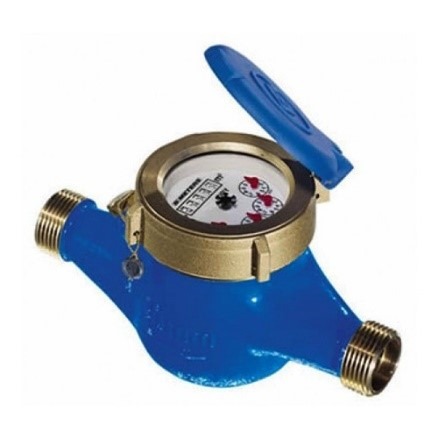
Water Meter
This is an example of a water meter.

Completing the self-reporting survey that’s COMING SOON will help Middlesex Water company track which customers do or do not need water service line replacement. You can also call 800-549- 3802 to report your service line material.

  • If you think your service line is made of lead, please contact the Middlesex Water Company 800- 549-3802 or submit the survey so we can confirm and take action. Middlesex Water Company will provide additional information about scheduling the inspection and replacement of your service line.
  • Once your ROE has been approved, a Middlesex Water Contractor will leave a doorhanger at your residence with a proposed date and time for replacement, along with the contractor’s contact information if the replacement must be rescheduled. You must be home at the time of replacement to allow the contractor to access to your service line from inside your house.

Exposure to high levels of lead is a serious health risk. Lead builds up in the body over many years and can cause damage to the brain, red blood cells, and kidneys. The greatest risk is to young children, pregnant women, and unborn babies. Amounts of lead that will not harm adults can slow down the normal mental and physical development of children, particularly those under 6 years old.

You can take several actions to decrease your lead exposure, including:

  • Replacing your lead service line.
  • Getting a National Sanitation Foundation (NSF)-Certified home water treatment device, faucet, or pitcher filter that removes lead. The device must be both NSF 42- and NSF 53- certified to remove lead. Devices and filters installed at the faucet will remove any lead contained in indoor plumbing and plumbing fixtures.
  • Buying plumbing fixtures (faucets, valves, sinks, hose bibs, etc.) that have zero- or low-lead content meeting the current “lead-free” requirements. Read the labels of any new plumbing fixtures closely.
  • Running tap water for about five minutes before you use it for drinking or cooking, if the water has gone unused for more than 6 hours. In doing so, you are flushing the stagnated water and getting fresh water from the water main pipe.
  • Using fresh, cold, running water for drinking, cooking, and preparing baby formula.
  • Removing and cleaning faucet screens and aerators every 6 months.

Yes. Human skin does not absorb lead in water. Bathing and showering should be safe for you and your children, even if the water contains lead over EPA’s action level.

Not during the lead replacement initiative. Middlesex Water Company will replace all lead and galvanized steel water service lines at no cost to the property owner or tenant. If the property owner chooses to not participate in the initiative, future replacement will be at the cost of the property owner.

Not necessarily. If you live in a building that was built prior to 1986, it is possible that your plumbing fixtures contain lead or lead solder was used at the joints of your interior piping. A licensed plumber can help figure out if you have lead material in your indoor plumbing, or you can use an EPA-approved Lead Test Kit More information on kits »

You should replace your lead service line to protect your personal health and your family’s health. No amount of lead is safe for humans to consume. Young children (under 6 years old) and the elderly can be more affected by lead exposure. They, along with pregnant women, may be at a higher public health risk to lead.

  • Once a survey is submitted by a customer, our experts review the submission, including the photos, and typically verify the submission within two weeks. Once the photos have been confirmed, the submitted survey will be “verified” and the new material will show up in the map. If our experts are unable to confirm the material from the photo, they will reach out to you for additional information.

Middlesex Water Company is offering free water testing to homes that have lead or galvanized service lines. Once an inspection is verified by our experts to be lead or galvanized, the option to request a free water sample kit will be available in the customer portal starting in October 2023.

  • Middlesex Water Company is prioritizing identifications and replacements between now and 2031 based on coordinating with other on-going work and based on socioeconomic and environmental factors. The 2023 and early 2024 replacements are focused in the Borough of Carteret. Replacements for the remainder of 2024 and beyond are still being determined by the Middlesex Water Company.
  • Once we have your material survey (if your pipe was previously unknown) and your signed right-of-entry (ROE) form, you are registered in the system and we will contact you when a contractor will be in your neighborhood to confirm your pipe is lead or galvanized and replace it at no direct cost.

MATERIALS VERIFICATION TEST

The Materials Verification Test below can help you figure out if you have a lead, galvanized steel, copper, or plastic service line on the portion of the service line you own. When you have completed the visual inspection, please submit your results using the following survey link. If you have a lead or galvanized steel service line, Middlesex Water will contact you to confirm the results and schedule your service line replacement.

What you need:

  1. House key or coin
  2. Strong refrigerator magnet

Steps to check your service line:

  1. Find the water meter in your basement or outside your home and look at the service line that enters the water meter.
  2. Use the house key or coin to carefully scratch the pipe surface.
  3. Compare the scratched area to the following descriptions:
    • If it looks shiny and silver, the pipe is made of lead. A magnet will not stick to a lead pipe.
    • If it is a dull gray color with no noticeable scratch on the surface, the pipe is galvanized steel. A magnet will stick to a galvanized steel pipe.
    • If it is the same color as a penny, the pipe is copper. A magnet will not stick to a copper pipe.
    • If it is smooth and red, blue, white, or black, the pipe is plastic. A magnet will not stick to a plastic pipe.
  4. Report your service line material in this SURVEY

ENTERPRISE ENVIRONMENTAL POLICY

THE MIDDLESEX WATER ENTERPRISE WILL:

• Comply with, or produce results better than, applicable laws and regulations set forth by state utility commissions and government environmental regulatory agencies.

• Include the consideration of environmental impact in all business strategies, initiatives and project plans.

• Work to ensure a reliable source of water supply.

• Promote respect for the environment as part of our Company’s culture among employees and our suppliers in their daily operations.

• Focus on reducing the amount of water lost (non-revenue) in our distribution system and employ leak detection and other available technology to achieve this goal.

• Prevent pollution, reduce waste and minimize the consumption of resources to minimize risks to the environment.

• Continually work to educate customers about the importance of protecting and preserving our natural resources and the importance of wise water use.

• Educate, train and motivate employees to carry out tasks in an environmentally responsible manner.

• Build in system resiliency to mitigate effects of climate change and other short and long-term climate related challenges.

• Use efficient practices that save fuel, energy and water.

• Work with our industry and legislative representatives to shape public policy and legislation that supports water objectives and helps ensure safe drinking water.

• Invest prudently in our systems for infrastructure stability, operational resiliency and continued sustainability utilizing sound asset management planning.

• Engage with our community to ensure responsiveness to local needs and interests.

• Work in collaboration with our communities, local municipal officials and our vendors to ensure a clean, safe, reliable and resilient water supply.